
What Is an NAD+ Skin Booster? The Complete Guide to Revergen: The Science, the Session Programme and the Right Expectations
NAD+ is a coenzyme present in every cell, and its level in the skin declines with age. Revergen places it at the centre of a clinical skin booster; this guide explains what the science says, what the manufacturer claims and what a clinic should weigh up before choosing it.
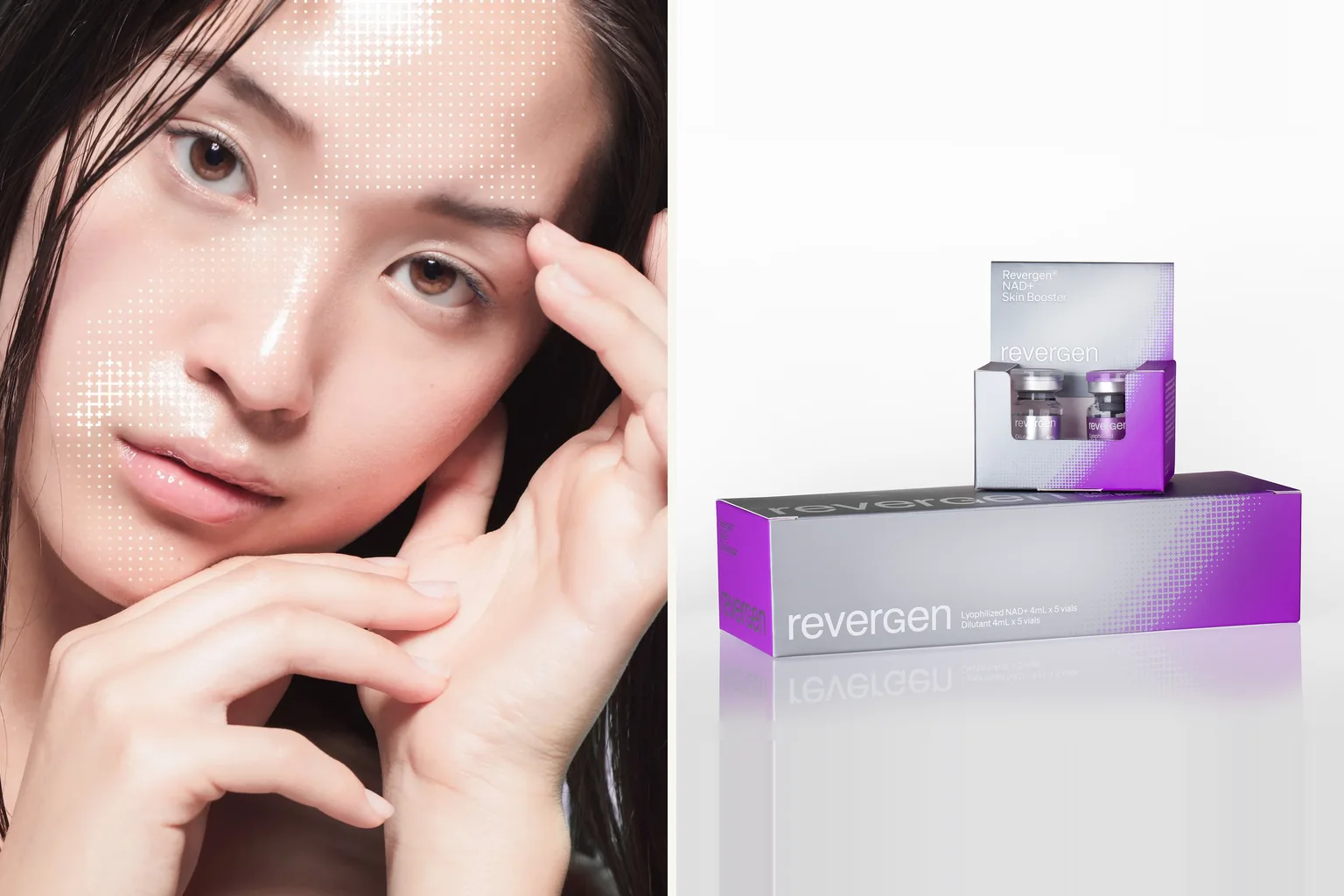
Over the past twenty years, skin boosters started with hyaluronic acid and moved on to PDRN, peptides and exosomes. Now a new name has arrived in clinics: NAD+, a molecule that every cell in the body needs to produce energy and repair itself. Revergen®, made by the Korean company Vita Medical, places this molecule at the centre of a skin booster and presents itself as the "fifth generation". This guide sets the manufacturer's official brochure and leaflet, line by line, beside scientific papers indexed in PubMed, to make clear what has been proven, what is a manufacturer claim and what a clinic should ask before choosing it.
If you only have a minute
- NAD+ is a natural coenzyme in every cell that plays a role in energy production (ATP), DNA repair and sirtuin activity.
- In human skin samples, NAD+ levels fell significantly with age; this finding is the scientific basis for the idea of "replenishing NAD+".
- Each Revergen set contains one 100 mg lyophilised NAD+ vial and one 4 mL diluent vial, and the product appears in both a 5-set box and a single-set box.
- The manufacturer's stated programme is three sessions 2 to 3 weeks apart, then one maintenance session every 2 to 3 months; storage is refrigerated at 2 to 8 °C.
- The manufacturer's current efficacy data consist of a report of two cases and a few before-and-after images; no controlled trial of the product itself has been published yet.
1. What is NAD+ and why does it matter for the skin?
NAD+ stands for nicotinamide adenine dinucleotide, a coenzyme present in every living cell that the body makes from the vitamin B3 family. Its first role is to carry electrons in the mitochondrial respiratory chain and so to produce ATP, the cell's main fuel. Its second role is less well known but more important for ageing: NAD+ is the substrate consumed by DNA-repair enzymes (PARPs) and by the sirtuin family, proteins involved in regulating the cell's response to stress and ageing.
The skin faces sunlight, pollution and oxidative stress every day, and its cells use energy and NAD+ to repair this damage. In the study by Massudi et al. (2012) of 49 human skin samples, from infancy up to the age of 77, NAD+ levels fell significantly with age in both sexes, while DNA damage and PARP activity rose at the same time. The authors concluded that the greater consumption of NAD+ to repair accumulated damage may be one of the mechanisms of tissue ageing.
2. "The fifth generation of skin boosters": how should Revergen's claim be read?
The Revergen brochure sums up the history of skin boosters in five generations: hyaluronic acid for hydration and volume, PDRN for regeneration and reducing inflammation, peptides for improving function, exosomes for cellular regeneration and, finally, NAD+ for "restoring the cell's natural function". The manufacturer's main argument is that the ingredients of earlier generations (such as PDRN derived from salmon DNA, or exosomes from cell culture) are foreign to the body, whereas NAD+ is a molecule the cell itself recognises.
This narrative is appealing from a biological point of view, but two points must be set beside it. First, the fact that a molecule is "natural" does not on its own prove the efficacy or safety of an injectable or clinical formula; the amount, form of presentation, accompanying ingredients and method of administration matter just as much. Second, the manufacturer does not set the earlier generations aside: in its "synergy" section it says that NAD+ enhances the effect of hyaluronic acid, PDRN, peptides and exosomes. This claim is reasonable, but the brochure does not support it with comparative data.
3. What is inside the Revergen box?
According to the official leaflet, each Revergen set consists of two vials: a freeze-dried (lyophilised) NAD+ vial containing 100 mg of NAD+ with a purple cap, and a 4 mL diluent vial with a silver cap. The large box is printed with "Lyophilized NAD+ 4mL × 5 vials / Diluent 4mL × 5 vials", which makes it the 5-set box; a small single-set box can also be seen in the official images. The lyophilised form is common for keeping sensitive molecules stable, and the vial is prepared before use with the diluent from the same set.
The manufacturer bases the formula on "six pillars": an NAD+ core to restore cellular rhythm, growth factor peptides for regeneration and texture, cellular structure support, an antioxidant layer against environmental stressors, a long-lasting hydration system and a nutrient delivery network. However, the exact names and amounts of the components of the other five pillars have not been published in the brochure; the clinic should read the full list from the leaflet for the same batch.
- NAD+ content: 100 mg per lyophilised vial.
- Diluent: a separate 4 mL vial in each set.
- Storage: refrigerated at 2 to 8 °C; cold chain from delivery to use.
- Authenticity: a scannable Hidden Tag label on every vial and a tracking system on every box.
- Declared standards: GMP manufacturing and ISO 13485:2016 and ISO 22716:2007 certification.
4. The scientific evidence: what we know and what we do not know yet
Conlon's review (2022) in Plastic and Reconstructive Surgery concludes that a decline in cellular NAD+ is a feature of ageing and that interventions that raise NAD+ may slow parts of the ageing process; the author stresses the link between basic research and aesthetic medicine. It should be noted that the author of this review is affiliated with a company active in the NAD+ field. The same article is cited in the Revergen brochure, but its journal details are given incorrectly (the correct version appears in the source list on this page).
The critical review by Bhasin et al. (2023) in Endocrine Reviews gives a more balanced picture: NAD+ declines over the lifespan, and its oral precursors can safely raise NAD+ levels in the blood, but its pharmacology, metabolism and therapeutic mechanisms are not yet fully understood, and large randomised trials are needed to prove efficacy. In the skin, the strongest clinical evidence so far concerns topical niacinamide (one of the precursors of NAD+), which in trials has slowed visible ageing and dark spots and is well tolerated; this finding cannot be directly generalised to injectable or clinical NAD+.
Revergen's own data in the brochure consist of two cases from a clinic in Seoul: in the first person, a fine-line index fell by an average of 25% after 4 weeks and two sessions, and in the second, a skin brightness index rose by 78% after two sessions. A separate file from the manufacturer also shows eight before-and-after images of different people. These data are useful for understanding the pattern the manufacturer expects, but they lack a control group, a standard measurement method, consistent timing of photographs and sufficient numbers; they are therefore an early signal, not proof.
5. The session programme and expected course according to the brochure
The manufacturer proposes a standard two-phase programme: an initial phase of three sessions 2 to 3 weeks apart to "rebuild the skin's foundation and cellular rhythm", and a maintenance phase of one session every 2 to 3 months. It is this structure that makes the 5-set box logical for clinics. The method of administration, depth, amount per session and number of sets needed are not given in the public brochure and must be determined only by a physician, on the basis of the leaflet for the same batch; LILWANA does not publish injection or mesotherapy training.
The course the manufacturer maps out for the patient has three milestones: 1 to 2 weeks after a session, improved tone and hydration with a natural glow; after one month, brighter skin with a more even texture; and after three sessions, improved elasticity, firmness and overall skin health. This timeline should be regarded as "the manufacturer's stated expectation"; the actual response depends on age, skin type, lifestyle, sleep and daily sun protection.
6. Who is Revergen intended for, and who should wait?
The brochure targets three groups: ageing skin that has lost elasticity and firmness over time (fine lines, sagging, reduced suppleness), dull and tired skin caused by stress and lifestyle (lack of vitality, a tired appearance, uneven tone), and skin whose barrier has been weakened by environmental stressors (loss of moisture and sensitivity to irritants). The manufacturer particularly targets people looking for gradual, natural rejuvenation at the early signs of ageing.
By contrast, for several groups the decision must be made only with a physician, and sometimes postponed; Revergen is a clinical product and is not for home use or self-injection.
- Pregnancy and breastfeeding.
- Active infection, inflammation or lesions in the treatment area.
- A history of severe allergy or of reactions to skin boosters and mesotherapy.
- An underlying condition, a clotting disorder or use of medicines that affect blood clotting.
- Expecting an immediate result, or a replacement for approved treatments for dark spots and melasma.
7. NAD+ alongside PDRN, exosomes and hyaluronic acid
Choosing a skin booster should start from the skin's needs, not from the name of an ingredient. Hyaluronic acid is the best-known option for basic hydration; PDRN and peptide combinations such as Glutanex Glow are mostly considered for texture, moisture and freshness; exosomes are still at the stage of regulation and standardisation. NAD+ occupies a new position: rather than filling or surface hydration, its aim is to support the cell's own energy and repair. Depending on the skin, a physician may regard these options as alternatives to, or complements of, one another; the manufacturer's claim of a "2.0 version" of each ingredient alongside NAD+ has not yet been backed by published comparative data.
8. A clinic's checklist before ordering Revergen
At LILWANA, Revergen is marked "coming soon": the product page is complete, but ordering has not opened yet. Register your mobile number on the page of either pack and we will let you know as soon as stock arrives. Until then, this list helps a clinic make a confident decision:
- Scan the Hidden Tag label on each vial and match the result against the batch number on the box.
- Ask about the delivery temperature; the product must have been transported in a 2 to 8 °C cold chain.
- Check the integrity of the seal, the purple cap of the NAD+ vial and the silver cap of the diluent.
- Ask for the leaflet for the same batch: the full component list, the preparation method and the conditions after preparation.
- Check authorisation and the permitted route of use in the destination market separately; the manufacturer presents the product as "cosmetic".
- For the three-session programme, the 5-set box makes more sense; for a first introduction, the single-set pack.
Frequently asked questions
What exactly does an NAD+ skin booster do?
Its aim is to support the energy and repair of the skin cells themselves; NAD+ plays a role in ATP production, DNA repair and sirtuin activity. The manufacturer of Revergen states improvements in radiance, texture, fine lines and elasticity, but these claims have not yet been confirmed by a controlled trial of the product itself.
How does Revergen differ from PDRN and exosomes?
PDRN is obtained from salmon DNA and exosomes from cell culture; instead of these, Revergen places at its centre NAD+, which occurs naturally in the body's cells. The difference is one of approach; clinical superiority of one over another has not been shown with comparative data.
What is in each Revergen box?
Each set is one 100 mg lyophilised NAD+ vial and one 4 mL diluent vial. The large box contains 5 sets, and a single-set pack can also be seen in the official images.
When do Revergen's results show and how long do they last?
The manufacturer states improved hydration and radiance 1 to 2 weeks after a session, brighter skin after one month and improved elasticity after three sessions, and it recommends one maintenance session every 2 to 3 months to maintain results. This timeline is the manufacturer's claim, and each person's response differs.
Can Revergen be used at home?
No. Revergen is a clinical product; preparation, method of administration and the amount per session are determined only by a physician or qualified specialist, and LILWANA does not provide injection or mesotherapy training.
How can I check that Revergen is authentic?
Every vial has a Hidden Tag label that can be scanned to check authenticity. At delivery, also check the batch number, the integrity of the seal and delivery in a 2 to 8 °C cold chain.
When will Revergen be available at LILWANA?
Both packs are marked "coming soon". Register your mobile number on the product page and we will let you know by SMS as soon as stock arrives.
Sources and scientific basis
Reputable educational and regulatory sources were used for the skincare claims. The information on each product must ultimately be checked against the label on that pack.
- Conlon NJ. The Role of NAD+ in Regenerative Medicine. Plast Reconstr Surg, 2022;150(4 Suppl):41S-48S
- Massudi H, et al. Age-associated changes in oxidative stress and NAD+ metabolism in human tissue. PLoS One, 2012;7(7):e42357
- Bhasin S, et al. Nicotinamide Adenine Dinucleotide in Aging Biology: Potential Applications and Many Unknowns. Endocr Rev, 2023;44(6):1047-1073
- Boo YC. Mechanistic Basis and Clinical Evidence for the Applications of Nicotinamide (Niacinamide) to Control Skin Aging and Pigmentation. Antioxidants, 2021;10(8):1315
- Revergen® NAD+ Skin Booster — official website (Vita Medical)