
A Daily Routine with Glutanex Products: Morning and Evening, Step by Step
In what order and when should you use Glutanex Cica Cream, Night Serum and Snow White Cream? A simple morning and evening routine with a patch test, sunscreen and tips for sensitive skin.
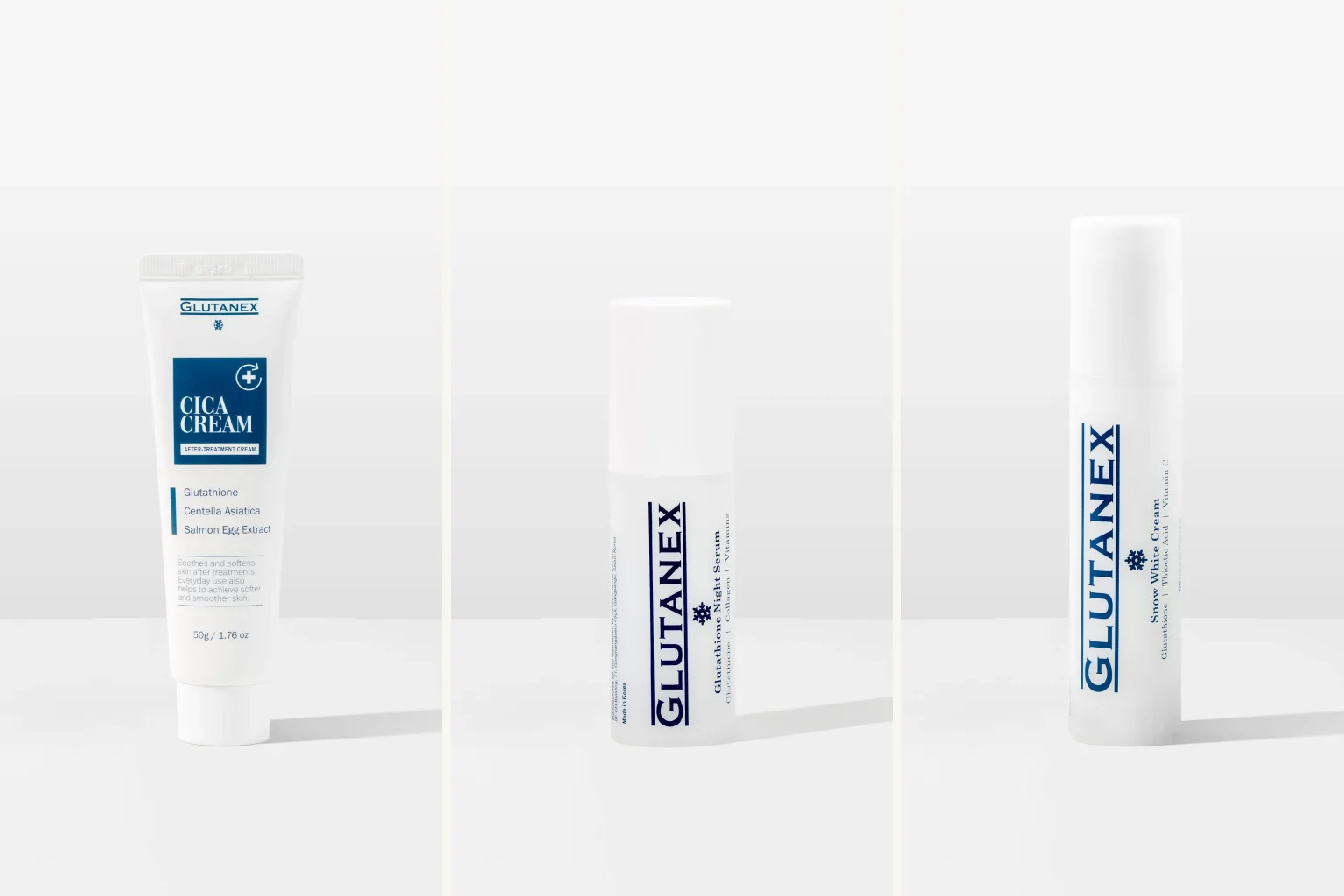
Most of the questions we receive about Glutanex home-use products have one root: "How do I use these together?". The short answer is that each product has a clear place: Cica Cream for calm and softness, the Night Serum to finish the evening routine and Snow White Cream for a daytime look. This guide builds a morning and evening routine, tells you which product to start with, how to add the next one and what is reasonable to expect from each step. Usage information is taken from the manufacturer's official page, and the label on your own pack is always the final reference.
If you only have a minute
- Start with one product; Cica Cream is a good starting point for sensitive and dry skin, and the Night Serum for dull, tired skin.
- Morning routine: gentle cleansing, Cica Cream or Snow White Cream, and always a reliable sunscreen as the last step.
- Evening routine: cleansing, toner, Glutanex Night Serum and, if needed, Cica Cream to lock in moisture.
- Snow White Cream gives a temporary tone-up effect and does not replace sunscreen; the Glutanex Sunstick is not a substitute for sunscreen either until its SPF label is verified.
- Do a patch test before every new product and leave a few days between adding products.
1. Start with one product, not all of them
Buying three products at once and starting them together both raises the cost and, if irritation occurs, makes it impossible to find the culprit. Your first product depends on your skin's main need: if your skin is sensitive, dry or tired after a period of active products, Glutanex Cica Cream is the most logical start. If your main concern is dullness and dryness at night, the Night Serum is a better starting point. Add Snow White Cream once your basic routine is stable and you only want a daytime look.
For each new product, the American Academy of Dermatology recommends first trying a small amount on a small area of skin (for example the inner forearm or behind the ear) and watching how your skin responds for a few days. This does not replace a medical test, but it does prevent a widespread reaction.
2. Morning routine: light, protective and short
In the morning the aim is to send your skin into the day calm and protected. You don't need many steps; the right order is what matters.
- Gentle cleansing with lukewarm water or a mild cleanser; sensitive skin usually does not need a strong cleanser in the morning.
- Glutanex Cica Cream: according to the manufacturer's source, about 1 ml, spread evenly over the face. If you have oily or combination skin, a smaller amount on dry areas only is enough.
- Or Glutanex Snow White Cream: if you want a more even look, spread a small amount instead of Cica Cream or after it, leaving a short gap. According to the source, its texture is non-sticky.
- Sunscreen with a reliable label: the permanent final step of the morning. The American Academy of Dermatology recommends a broad-spectrum sunscreen with SPF 30 or higher, reapplied roughly every two hours outdoors.
3. Evening routine: cleanse, serum, lock in moisture
The evening is the time for consistent care. According to the official guidance, Glutanex Night Serum is used after cleansing and toner, and if your skin is dry, Cica Cream can lock in moisture. The Night Serum is presented for hydration and softness; the manufacturer's claim of "results by morning" is not a LILWANA guarantee.
- Cleansing: if you wore sunscreen or make-up, remove it thoroughly and then use a mild cleanser.
- A gentle, alcohol-free toner; if you don't use a toner, skip this step rather than buying a new product.
- Glutanex Night Serum: no numerical amount is given in the source; a few drops for the whole face is usually enough, and the label on your pack is the reference.
- Glutanex Cica Cream as the last step for dry or sensitive skin; optional for oily skin.
4. Adjusting the routine to your skin type
Sensitive skin: start with Cica Cream, wait two weeks, then add the Night Serum. Introduce Snow White Cream only once the routine is stable and after a patch test. If you are also using a retinoid or acid, use them on separate nights.
Dry skin: all three products have a place: the Night Serum and Cica Cream at night, Cica Cream or Snow White in the morning. If tightness persists, the problem is probably over-cleansing, not a lack of products.
Combination and oily skin: use Cica Cream only on dry areas and at night. In the morning, a small amount of Snow White Cream and a light sunscreen is usually enough. The T-zone does not need many layers.
5. Common mistakes that spoil a routine
- Using Snow White Cream instead of sunscreen; the tone-up effect is cosmetic and offers no UV protection.
- Expecting home-use products to remove dark spots or lighten the skin permanently; these are care products, not treatments.
- Applying Cica Cream to an open wound or immediately after a procedure without the opinion of the specialist who performed that treatment.
- Starting three products on the same night and then being unsure what caused the irritation.
- Storing products in the bathroom or by a window; all products should be kept in a cool, dry place away from direct light with the cap closed.
- Putting the serum in the fridge without the label saying so; the source gives no exact temperature, and without an explicit instruction, the fridge or freezer is not recommended.
6. What is reasonable to expect, and when?
A feeling of hydration and softness is usually noticeable in the first few days, and the tone-up effect of Snow White Cream is visible straight after application and disappears when the product is washed off. For visible changes in dullness or texture, the official source gives no specific timeframe and LILWANA promises no figure or percentage either. The best indicator is how well your skin tolerates consistent use: if after a few weeks your skin is calmer and better hydrated, the routine is doing its job.
If you notice burning, redness or persistent irritation, stop using the product. If you have an underlying condition such as eczema, active acne or melasma, coordinate your decision with a dermatologist; Glutanex products are not a substitute for treatment.
Frequently asked questions
How many times a day should I use Glutanex Cica Cream?
According to the manufacturer's source, about 1 ml, 2 to 3 times a day. For oily skin, once at night on dry areas is usually enough. The label on your pack is the final reference.
Should I apply Glutanex Night Serum before or after cream?
The serum is used after cleansing and toner and before cream. If you have dry skin, apply Cica Cream after the serum to retain moisture.
Does Glutanex Snow White Cream contain sunscreen?
No. This is a daily tone-up cream with a temporary cosmetic effect. Daily protection must come from a sunscreen with a reliable label and SPF 30 or higher.
Can I use all three products together?
Yes, but not from day one. Start with one product, wait a few days to two weeks, then add the next product so that any reaction can be traced.
Are Glutanex products suitable during pregnancy?
The full cosmetic ingredient list of these products is not disclosed in the official source. During pregnancy and breastfeeding, discuss any new product with your physician.
Can I use Cica Cream after laser or microneedling?
Only with the approval of the specialist who performed that procedure. Do not use it on damaged skin or an open wound without a specialist's opinion.
Sources and scientific basis
Reputable educational and regulatory sources were used for the skincare claims. The information on each product must ultimately be checked against the label on that pack.
- American Academy of Dermatology — How to test skin care products
- American Academy of Dermatology — Sunscreen FAQs
- Bylka W, et al. Centella asiatica in cosmetology. Postepy Dermatol Alergol, 2013
- Watanabe F, et al. Skin-whitening and skin-condition-improving effects of topical oxidized glutathione. Clin Cosmet Investig Dermatol, 2014